
More powers Scotland Bill published at Westminster
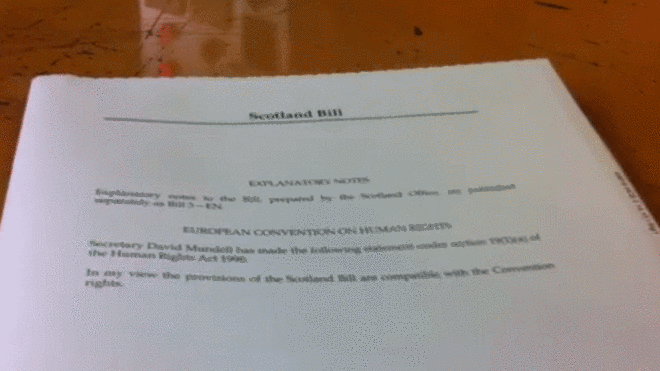
Legislation giving more powers to the Scottish Parliament is due to begin its journey through Westminster.
The Scotland Bill, outlined in the Queen’s Speech, could become law by February 2016 if approved by MPs.
David Cameron said the legislation would make Scotland the most powerful devolved assembly anywhere in the world.
But the SNP has said it did not meet the recommendations of the Smith Commission.
Scottish Secretary David Mundell will lay the Scotland Bill before the House of Commons, with discussions on the principles of the legislation due to take place next month.
He told BBC Radio’s Good Morning Scotland programme: “I am very keen that we get on to implement it [the Scotland Bill] so the Scottish Parliament has these powers, the Scottish government can then take the decisions that they say they need to do to make changes in Scotland in relation to the economy, welfare and other matters.”
Income tax
If it passes the usual parliamentary hurdles it could become law early next year, ahead of the Holyrood elections in May 2016.
The UK government said the new bill would embody the Smith Commission agreement which was signed by the SNP, the Conservatives, Labour, the Liberal Democrats and the Scottish Greens in November last year.
The promise of more powers to Holyrood followed voters rejecting Scottish independence by 55% to 45% in last September’s referendum.
The key elements of the Scotland Bill include:
- allowing Holyrood to set thresholds and rates of income tax on earnings in Scotland and keeping all the money raised in Scotland
- giving the Edinburgh parliament control over the first 10 percentage points of standard rate VAT revenue raised in Scotland [and 2.5% reduced rate]
- new welfare powers worth £2.5bn
- enabling the Scottish government to vary the frequency of Universal Credit payments in Scotland
- providing power to set the rules over a range of benefits which affect carers, disabled people and the elderly
- and giving control over programmes which help people find work.
Before the Queen’s Speech, SNP leader and Scotland’s First Minister Nicola Sturgeon said she wanted the Scotland Bill to go much further than the Smith proposals.
She had been keen to see Holyrood given full control over National Insurance, the minimum wage, Corporation Tax, full control of welfare and employment and trade union law.
However, the Bill does not contain any of those demands.
Clauses change
Ahead of the Bill coming before the UK parliament, Scotland’s Deputy First Minister John Swinney questioned whether it would fulfil the recommendations of the Smith Commission.
He told Good Morning Scotland: “The big test later on this morning will be whether or not David Mundell and the Conservative government have listened to all the constructive input that we have given to ensure that the draft clauses published in January have been changed.
“And changed satisfactorily to address, not just my concerns and the concerns of the Scottish government, but the concerns of five political parties on the Devolution (Further Powers) committee of the Scottish Parliament.”
Mr Mundell said the parliamentary process would allow for debate and amendments but any proposed amendments must be made in an “evidenced way”.
He added: “If others have proposals they need to bring them forward in an evidenced way – to show why these additional powers would be required, what benefit they would bring to Scotland and how they would affect the UK as a whole.”
Read more:http://www.bbc.com
Short URL: https://www.choicetv.org.uk/?p=3777
